Data Before Intelligence: Why Nonprofits Must Fix Their CRM Foundation Before Scaling AI
Generative AI can only be as good as the data it reasons over. For most Nonprofits, that data is still scattered across spreadsheets, legacy databases and disconnected tools. Organizations that unify it in Salesforce Nonprofit Cloud (or any other CRM) first will capture AI's value; those that skip this step risk automating their blind spots.
The Nonprofit AI paradox: adoption is rising faster than readiness
Nonprofits are moving quickly on AI. Salesforce's 2025 Nonprofit Trends Report, based on a survey of 1,229 organizations, found that 55 percent are now piloting or using AI, while 63 percent cite data privacy as a concern (Salesforce Trailblazer Community). Staff are already pasting donor lists into ChatGPT, asking Copilot to summarize grant reports, and using Claude to draft impact narratives.
Yet in our work with Nonprofit leaders, the results are uneven. A development director asks an AI assistant to identify major-gift prospects and receives a list that includes lapsed donors, duplicates and a board member's spouse recorded three different ways. A program manager requests an outcomes summary and gets numbers that contradict the annual report.
The problem is rarely the model. It is the data. Gartner estimates that poor data quality costs organizations an average of $12.9 million a year (Gartner via Boomi). In the Nonprofit sector, the cost is measured not only in dollars but in lost donor trust, missed grant deadlines and programs steered by the wrong signals. AI does not fix that cost; it amplifies it, at speed and with confidence.
Three ways fragmented data misleads AI
A typical mid-sized Nonprofit might run fundraising in one database, programs in another, volunteers in a third, and finance and grants in spreadsheets. General-purpose AI tools see only the fragment they are handed, and they rarely signal what is missing. Three failure modes recur.
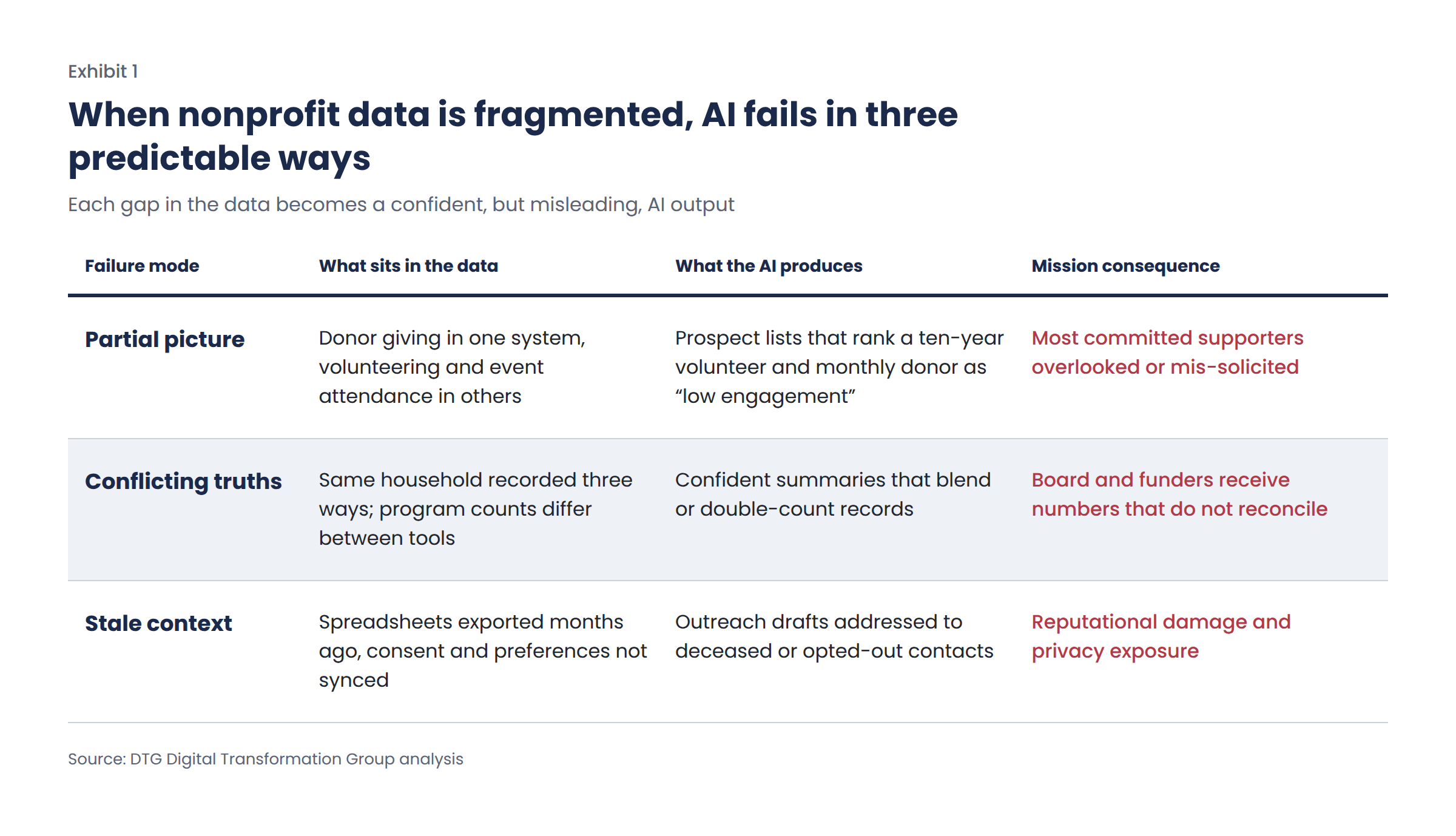
The common thread: generative AI is fluent, not skeptical. It fills gaps with plausible language rather than flagging them. The more polished the output, the harder errors are to catch, and no prompt, however clever, can recover information the tool was never given.
Why the CRM must come first
The answer is not to stop using AI, but to change the sequence. Leading Nonprofits treat their CRM as the single source of truth and let AI tools draw from it, rather than letting each tool build its own partial view.
Salesforce Nonprofit Cloud is built for this role. It brings fundraising, program management, volunteer engagement, grantmaking and outcomes into one data model on the Customer 360 platform. A person is one record, whether they give, volunteer, receive services or sit on the board. Households, relationships, gifts and program participation connect to that record. But migration alone is not the fix: loading inconsistent spreadsheets into a new CRM simply relocates the inconsistency. CRM is only as valuable as the data it contains. Investing in regular data audits, duplicate prevention, and governance ensures better reporting and decision-making. The true strategic power of Salesforce is unlocked when users have real-time access to clean, actionable insights.
Three properties of a well-implemented Nonprofit Cloud matter most for AI:
One constituent, one record. Deduplication and household rules give AI an unambiguous view of every supporter.
Shared definitions. Terms such as "active donor", "program completion" and "restricted gift" are defined once, so every tool and report counts the same way.
Governed access. Consent, privacy preferences and permission sets control who sees what, so sensitive service records stay out of fundraising views. These controls do not follow data exported into an external AI tool, so every integration must enforce them too.
A single source of truth does not require a single system. Finance can stay in the accounting platform and specialist service tools can remain in place. What matters is that every data element has one agreed system of record, integrations refresh on a schedule with reconciliation checks, and uncontrolled spreadsheet copies give way to governed reports.
Once that foundation is in place, AI becomes far more useful. Whether the tool is Salesforce's own Agentforce, or Claude, Copilot or ChatGPT connected through governed integrations, it reasons over a coherent, current and trusted picture.
A data-first roadmap to AI readiness
Getting the foundation right does not require a multi-year transformation. The most effective approach starts with one bounded, high-value use case, such as donor briefings drafted from approved CRM records, and builds the data foundation for that case first. The Nonprofits that succeed follow a clear sequence, with explicit gates that stop AI pilots from outrunning the data beneath them.
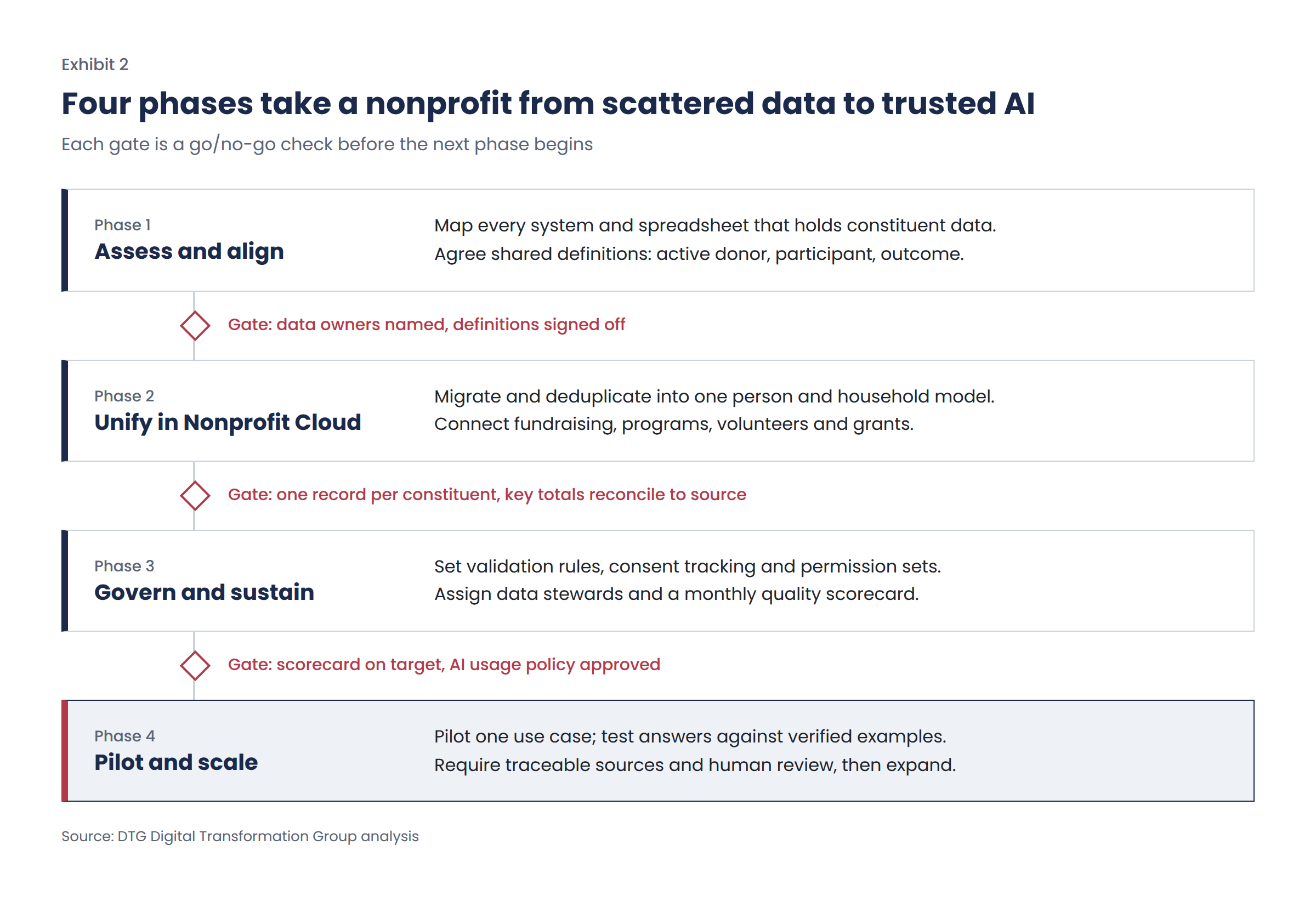
Each gate is a go/no-go check. AI moves to the center of daily work only once the CRM reconciles, owners are accountable and staff know the rules. Organizations that already run Nonprofit Cloud can often move through the first three phases quickly; those still on spreadsheets should expect the unification phase to carry most of the effort, and most of the value.
Clean data reduces AI errors but does not eliminate them. Financial and outcome totals should be calculated in validated Salesforce reports, with AI used to explain the numbers rather than compute them. Staff should always be able to trace an answer back to the underlying records.
Questions every Nonprofit leader should ask
Before approving the next AI pilot, executive directors and boards can test their readiness with five questions:
Can we produce one agreed number for active donors, program participants and outcomes?
How many systems and spreadsheets hold constituent data today, and who owns each?
Would our AI tools see consent and privacy preferences before they draft outreach?
Do our staff know which data they may share with external AI tools, and which they may not?
Who is accountable for data quality after go-live, and how will we verify AI answers before they reach donors or funders?
If the answers are unclear, the most valuable AI investment this year may not be an AI tool at all. It may be the disciplined work of unifying data in Nonprofit Cloud. Its first returns arrive before any AI is switched on: consistent reporting, less manual reconciliation and clearer accountability. Organizations that do this work first will find that AI amplifies their mission. Those that skip it will find that AI amplifies their confusion.
Have questions or want to explore how we can support your Salesforce Nonprofit Cloud & AI journey?